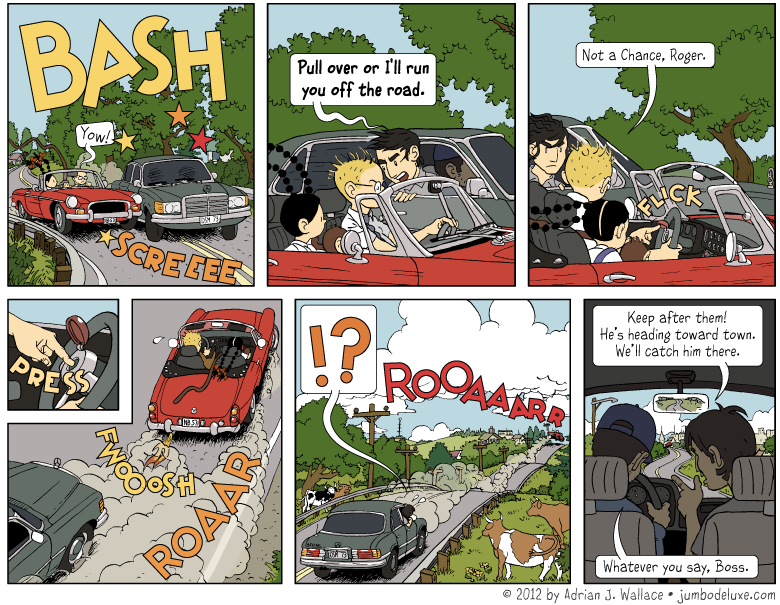
Basement Clue

Next Time: Don’t sit down

└ Tags: , , ,

Happy new year everybody! 2011 was a busy year at Jumbo deLuxe studios and while I regret that I didn’t make as many comics as I hoped, the quality is there and I feel like my work has been really improving. My main goal for 2012 is to increase the frequency of updates, while keeping the level of quality. If I can’t update frequently with comics then I will at least try to post a sketchblog from time to time, which brings  me to…

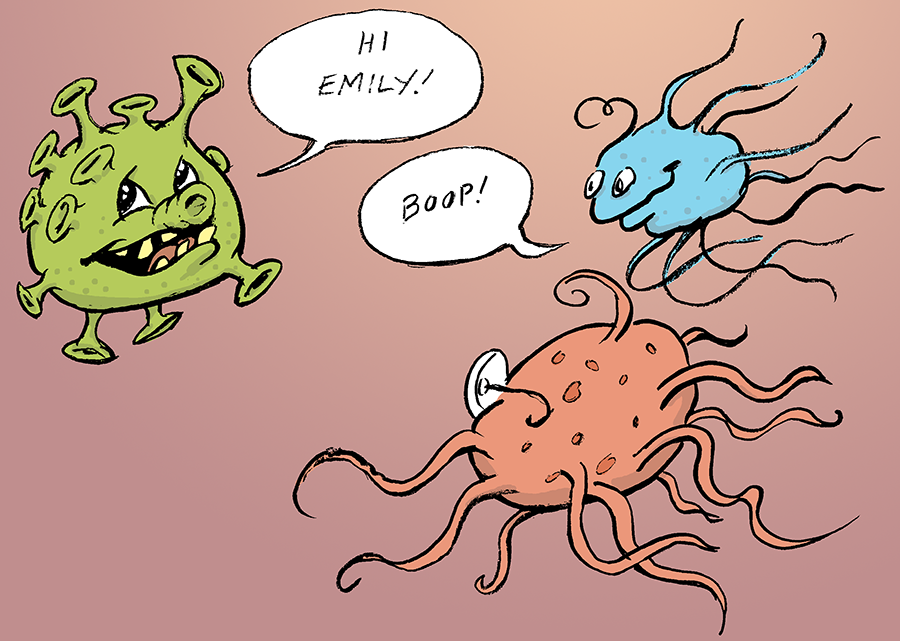
A fan art doodle I made for Barry Deutsch's Hereville comic

Emily and The Dog pay a visit to Hereville and meet Mirka and The Pig.

Some fan art I recently made for my pal Barry Deutsch and his beautiful webcomic turned printed-on-paper book, Hereville! Barry is a brilliant storyteller and expert cartoonist; and he’s offered some great advice and encouragement on Jumbo deLuxe comics. Go and read it at once, keep in mind that the webcomic version is a sort of rough draft for the book which is longer and has some stunningly gorgeous artwork. I think Hereville should appeal strongly to the readers of Jumbo deLuxe comics, since we both feature a feisty young female adventurer with long braids and tiny dots for eyes. I swear I was doing this sort of thing long before I became aware of Hereville and met Barry.

I made this drawing on the same day I saw that Spielberg Tintin Movie (with Barry no less!) and I’m happy to say that despite all my nay-saying that I actually enjoyed the movie a lot even though there were a few clunky moments. The thing to remember is that it’s Spielberg making a tribute to Hergé’s Tintin as fun-filled action adventure film, and not a direct adaptation. That Uncanny valley thing still creeped me out a little, though. For a more detailed (but not much more) review, please check this one I posted in the comments section of the sci-guys site.

I’ll be back with some more comics very in a few days, this year is going to be a lot of fun. See you soon!


It seems safe to say that Hergé and Tintin occupy a similar place in the cultural consciousness of Europe as the Disney organization in the Americas, or as Tezuka has in Asia.

When people first see my work they’ll sometimes say that “It looks like Tintin”. I take this as a great compliment because I’m a huge fan, and the series has greatly informed my work as a cartoonist. I received my very first Tintin Book as a Christmas gift when I was seven years old, already obsessed with images from the funny pages, and shortly afterwards began trolling book stores and public libraries to find the rest of the series or anything similar. This lead to a lifelong voyage of discovery of many other great European comics and vintage comic strips, which I’ll detail in future blog posts.

Tintin Covers by Hergé

All 24 Tintin books Hergé, in French. Note: even the questionalble ones are here

As a 7 year-old, I didn’t really think about how these books were created. Nor did the books themselves provide much information as to who this mysterious Hergé was, or the social or historical contexts in which they were made. Growing up in Canada before the internet emerged, I didn’t have access to this information until later in life.

Learning about Tintin and other European comics bit by bit, I eventually filled in the gaps after a visit to France, and reading the excellent book Tintin and the World of Herge: An Illustrated History by Benoit Peeters.

If you’re at all interested in Tintin, you need to read this book. Especially for us in the Americas, where none of this is common knowledge. Or you can simply go to wikipedia or Tintinologist.org and read about it there. It’s all good.

If you’ve never read any Tintin before, you might be wondering about a good place to start. (Hurry before that movie comes out and ruins everything!) It’s helpful to know the years in which they were made, and have some understanding of the historical and cultural context for some. There are 24 books in the series, 21 of which are widely available. To help things along, I’ve cobbled together this table with the help of wikipedia.

I have applied a personal opinion for each one whether I consider this book suitable for beginner, intermediate, or advanced readers. Consider yourself a beginner if you’ve never read any Tintin before, whatever your age. Intermediate books are best if you have already read a few books and familiar with the world that they represent. Advanced books may not appropriate for very young readers or folks who don’t like to get to get confused with unfamiliar contexts. My tags do not necessarily reflect on the overall quality of the book or if it’s a personal favorite of mine (I’ll get to that in a moment).

1 Tintin in the Land of the Soviets (Tintin au pays des Soviets) (1929-1930) Advanced
2 Tintin in the Congo (Tintin au Congo) (1930-1931) Advanced
3 Tintin in America (Tintin en Amérique) (1931-1932) Advanced
4
5
Cigars of the Pharaoh (Les Cigares du Pharaon)(1932-1934)
The Blue Lotus (Le Lotus bleu)(1934-1935)
Intermediate
6 The Broken Ear (L’Oreille cassée) (1935-1937) Intermediate
7 The Black Island (L’Ile noire) (1937-1938) Intermediate
8 King Ottokar’s Sceptre (Le Sceptre d’Ottokar) (1938-1939) Beginner
9 The Crab with the Golden Claws (Le Crabe aux pinces d’or) (1940-1941) Beginner
10 The Shooting Star (L’Etoile mystérieuse) (1941-1942) Beginner
11
12
The Secret of the Unicorn (Le Secret de la Licorne) (1942-1943)
Red Rackham’s Treasure (Le Trésor de Rackam le Rouge) (1943)
Beginner
13
14
The Seven Crystal Balls (Les Sept boules de cristal) (1943-1946)
Prisoners of the Sun (Le Temple du soleil) (1946-1948)
Beginner
15 Land of Black Gold (Tintin au pays de l’or noir) (1948-1950) Advanced
16
17
Destination Moon (Objectif Lune) (1950-1953)
Explorers on the Moon (On a marché sur la Lune) (1950-1953)
Beginner
18 The Calculus Affair (L’Affaire Tournesol) (1954-1956) Beginner
19 The Red Sea Sharks (Coke en stock) (1956-1958) Intermediate
20 Tintin in Tibet (Tintin au Tibet) (1958-1959) Intermediate
21 The Castafiore Emerald (Les Bijoux de la Castafiore) (1961-1962) Intermediate
22 Flight 714 (Vol 714 pour Sydney) (1966-1967) Beginner
23 Tintin and the Picaros (Tintin et les Picaros) (1975-1976) Intermediate
24 Tintin and Alph-Art (Tintin et l’Alph-Art)
Unfinished, published posthumously
Advanced
25 Tintin and the Lake of Sharks (Not written or drawn by Hergé.) Don’t bother.

So if you’re starting out, I recommend going somewhere in the middle, or at least no earlier than Cigars of the Pharoah. The earliest books are loosely adapted from work at the beginning of Hergé’s career, when Tintin was a weekly adventure comic strip. Hergé regarded this early work as something as a fun hobby or a prank, and never expected it to take off to become a huge sensation. These early comic strips which are adapted into the first 3 books are very loose and shambling stories which betray a naïveté and sometimes outdated colonialist view of the world. Nonetheless they are very fun, occasionally silly, and a remarkable insight into the mind of a young cartoonist developing his craft. In today’s world, readers may find the ethnic and cultural stereotypes shocking, and inappropriate for a childrens’ literature.

The series develops a loose continuity as it goes along, as subsequent books rely more on recurring characters and locations. Later books play heavily on references to obscure characters and events found in earlier books, however they are not crucial for understanding the story, but instead add richness and detail for the whole series.

Only a few stories are divided into distinct two-parters which follow a direct continuity, and should best be read together.

My personal favorite is the set of The Seven Crystal Balls followed by the Prisoners of the Sun. Other great places to jump in are King Ottokar’s Sceptre (features impressive world-building), or The Crab with the Golden Claws (Introduces Captain Haddock). If you’re feeling more adventurous and somewhat familiar with historical events in Asia in the 1930′s, then Blue Lotus is a great place to start. Some of the most beloved and timeless adventures occur later with Tintin in Tibet, Calculus Affair, Castafiore Emerald, and Flight 714. These are best appreciated with an understanding of the characters and continuity of earlier stories, but still stand up on their own.

Likewise, the artwork becomes tighter and given more objectivity as the series progresses, while losing much of the liveliness seen the early stories.

One of the strangest books in the series, despite its strong storytelling is The Black Island, having been completely re-drawn for greater authenticity in later book editions. Anachronisms pop up all over the place since the author’s storytelling style and continuity is rooted in 1937, but the artwork is contemporaneous to the world of 1966.

Land of Black Gold is another oddity since it was begun and left unfinished upon the German occupation of Belgium in 1940; completed in 1950, and considerably re-worked in 1971 to avoid controversy with the Palestinian / Israeli conflict.

I’m hard pressed to narrow down to one favorite Tintin story since they can be enjoyed on different levels. If you have a favorite Tintin Adventure, please let me know.


Background drawing

Street Background

I really get into drawing backgrounds for my comic. It’s nice to show the world the characters live in, and it’s similar to the neighborhood where I live in North Portland, Oregon. I like to make things convenient — If I ever get stuck on how to draw something, I can just look out the window or take my dog for a walk. I’d rather do this than research images on faraway places using the internet.

Until recently, I was making up the house where Nathan, Emily, and the dog live. I’m going to try to be more consistent with that so I’ve drawn a floor plan and even made a quick model of it in Google SketchUp. (You may notice some inconsistencies with the earlier strips as to where certain rooms and doors are located) Maybe one day I’ll go back and pull a ‘George Lucas’ to fix those things.

Another backgrounds trick I use like crazy is drawing a single background and re-using it for multiple panels. I’ve done this several times in the past. Most recently I did it for the April 26 comic, where the same background occurs 4 times. Many years ago I used to do this with tracing paper and re-ink the whole thing. Nowadays I ink and color once in the computer and then duplicate it to a new layer as many times as I want. You young cartoonists have it so easy. I don’t consider this ‘cheating’. Making comics is a graphic art not fine art (even though I do it for myself) I’m entitled to use any technological shortcuts so long as I don’t wear them out. (Caveat: Other cartoonists may consider what they do a ‘fine art’ and I’m okay with that. I’m just talking about my own comics here.)

Emily likes Yellow Magic Orchestra, and you should too.

Tighten Up, by Yellow Magic Orchestra

I really like to draw big and shrink it all down for the web. I do this to make my clumsy inking and other mistakes disappear. A lot of cartoonists do this, but I’ve since decided to draw really, really big after I saw some original drawings by Winsor McCay and George McManus. (Everyone must have drawn big in those days.)

Sadly, a lot of fun little details disappear alltogether, like the names on Nathan’s posters and record albums from a recent strip. You can check the close-up here. And if you’re not reading them already, go check out these fine webcomics, all featured on Nathan’s wall. Tell them I sent you.


I’m a big fan of the sci-guys podcast, having gone to hi-school and college with their ringleader Sci-Guy Jim. Recently the Sci-Guys posted a challenge for me to draw their robotic mascot, via their twitter. I was happy to oblige.

A drawing of Sci Bot 9000

Sci-Bot 9000 and the infamous Wheelhouse

Until this time, I have only seen Sci-Bot 9000 depicted from the above the torso, so I’ve tried to guess what his arms and legs look like. Shortly after my contribution was posted, Martin, another friend of the Sci-Guys posted his 3D version.
If you like science fiction, comics, videogames, beer, and movies you might want to check out their site and give a listen to their podcast. They often go into digressions that Nathan would find fascinating. (For example, who would win a battle of an Imperial Walker from Return of the Jedi versus ED-209 from Robocop?)

Frequent visitors to this site will probably notice that I’ve not updated the main comic lately. Hopefully this will tide you over if you’re craving some new robot drawings. The regular comic postings will resume after I’ve sorted out some personal and professional matters. Thanks for waiting.